José Henrique Stringhini Receives 2026 NOVUS International Teaching Award
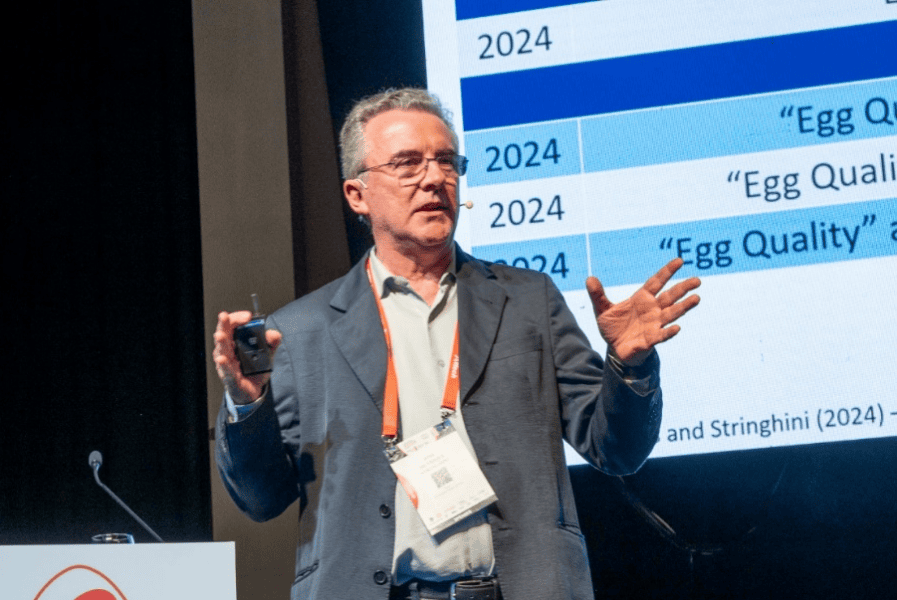
PARANÁ, Brazil (Oct. 9, 2026) – José Henrique Stringhini, DSc., was named the recipient of the 2026 NOVUS International Teaching Award during the Poultry Science Association Latin American Scientific Conference in Paraná, Brazil. Stringhini was recognized for his commitment to student development, scientific education and preparing future professionals to contribute to poultry production in Brazil and around the world.
Stringhini is a professor in the Department of Animal Science at the Veterinary and Animal Science School of the Federal University of Goiás in Goiânia, Goiás, Brazil. During nearly 35 years at the university, he has taught undergraduate and graduate students with a focus on poultry nutrition and production.
His academic career spans more than 40 years in poultry and swine production and includes teaching, research and mentorship. He has supervised more than 290 undergraduate, graduate and postdoctoral students while conducting research in non-ruminant nutrition. He also serves as a reviewer for scientific journals and regularly speaks at scientific and industry meetings in Brazil, Latin America and other regions.
“Professor Stringhini has dedicated his career not only to advancing poultry science, but also to developing the people who will carry that science forward,” says Gabriela Cardoso, Poultry Solutions senior manager for NOVUS in Latin America. “His commitment to connecting scientific knowledge with the realities of animal production helps students understand both the responsibility and the opportunity that come with a career in agriculture. NOVUS is pleased to recognize his lasting contribution to poultry education in Latin America.”
For Stringhini, effective teaching requires professors to go beyond reading text. His approach encourages students to question established ideas, critically evaluate evidence and develop their own scientific and professional identities.
“I believe professors should facilitate learning rather than simply transmit information,” Stringhini says. “The most lasting educational impact is not the amount of information transmitted, but the ability to inspire students to continue learning, think independently and contribute to society with scientific rigor, ethics and responsibility.”
Stringhini’s own path to academia was influenced by both practical agricultural experience and the educators who encouraged his scientific curiosity. Early fellowship opportunities exposed him to fruit and grain production, administration, and poultry and swine production. During a fellowship with EMBRAPA Swine and Poultry, his work with Dr. Fernando Rutz encouraged him to pursue a master’s degree and consider an academic career. At the Federal University of Viçosa, professors Horacio Rostagno and Marly Tafuri played important roles in his scientific development. Laterexperiences at the State University of Ponta Grossa, University of Brasília and EMBRAPA Cerrados further confirmed his interest in becoming a researcher and professor.
Today, Stringhini brings that combination of scientific inquiry and practical experience to his students. In animal nutrition and feeding, he connects scientific principles with challenges involving animal production, health, sustainability, economics and resource efficiency. Research is also an important part of his teaching approach, giving students opportunities to formulate questions, design experiments, analyze data and defend evidence-based conclusions.
He says agriculture offers young professionals an opportunity to apply that knowledge to some of society’s most significant challenges, including food security, sustainability, animal health and welfare, efficient resource use and climate change.
“Agriculture is food. Agriculture is science. And the world needs both,” Stringhini says. “Brazil is a reference in many areas of agriculture and animal science, and there are excellent opportunities here and around the world. Young professionals need a strong scientific and technical foundation, practical experience and a willingness to continue asking questions.”
As agricultural science evolves, Stringhini says educators also have a responsibility to prepare students for emerging technologies. He encourages future professionals to understand developments in precision technologies, omics, artificial intelligence and machine learning while remaining grounded in scientific principles and the realities of agricultural production.
“Technology should be a tool to expand our ability to understand production systems and develop solutions that are more efficient, sustainable, and appropriate to different production contexts,” he says.
The NOVUS International Teaching Award recognizes educators who demonstrate excellence in teaching and a commitment to advancing poultry science education. Through nearly 35 years at the Federal University of Goiás, Stringhini’s influence on students, research and poultry science reflects the principles the award was created to recognize.
About the Poultry Science Association
The Poultry Science Association is dedicated to advancing the discovery and dissemination of scientific knowledge to support the poultry industry through research, education and professional development. Learn more at poultryscience.org.
About NOVUS
NOVUS is a global leader in intelligent nutrition, combining scientific research, innovative solutions and industry expertise to help animals around the world reach their full potential.